
Economics and Benefits Analysis
Awards
Encourage your students to enter their abstract for the annual SRA meeting!
Frequently the EBASG provides $500 and waives the meeting registration fee for the best student abstract submitted and presented at the SRA annual meeting in the area of economics and benefits analysis.
Interested students should indicate that they would like to be considered for this award when they submit their abstract for consideration by the annual meeting Committee. To receive the award, applicants must be students at abstract submission deadline and must attend the annual meeting. Applicants may apply to multiple specialty groups; however, each applicant may only hold one award.
The Student Merit Award is completely independent from the need-based SRA travel awards given to students and international applicants to attend the annual meeting. Any Student Merit Award winner may also apply for and receive need-based student and international travel funding.
The award is presented at the EBASG business meeting during the annual meeting.
Past Awardees
Student Merit Award Winner: We are pleased to announce that the 2025 Student Merit Award winner was Ms. Jia Choi, from the University of Buffalo. Ms. Choi made a presentation of her work at the SRA annual conference held in Washington DC from December 07th – 11th, 2025. She was awarded her winner certificate by incoming EBASG Committee Chair Sandra Hoffman, PhD during EBASG annual gathering at the conference.
Below is Ms. Jia Choi receiving her Student Merit Award Certificate from Incoming EBASG chair Sandra Hoffman. Standing next to her is Joseph Njau, the outgoing EBASG secretary.
2025 Awardee
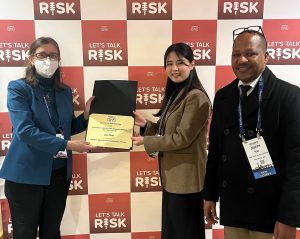
Jia Choi, University at Buffalo – SUNY, “Modeling Strategic Interactions Among Homeowners, Insurers, and Regulators in Wildfire-Prone Insurance Markets: A Game-Theoretic Approach”
2023 Awardee
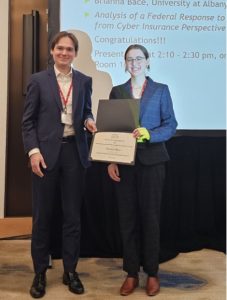
Brianna Bace, University at Albany – SUNY, “Analysis of a Federal Response to Catastrophic Cyber Risk from a Cyber Insurance Perspective”
2021 Awardee

Esther Jose, University at Buffalo, “Public-Private Partnership of Prescribed Fires”
2020 Awardee
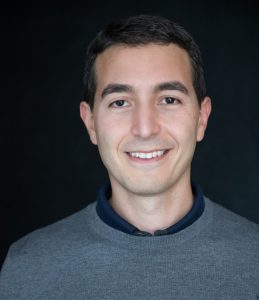
Michael Eber, Harvard University, “The Modest Effects of Fact Boxes on Cancer Screening”
After receiving the SRA EBASG Student Merit Award, Michael’s article was published in February 2021 in the Journal of Risk and Uncertainty: https://link.springer.com/article/10.1007/s11166-021-09344-x
2018 Awardee
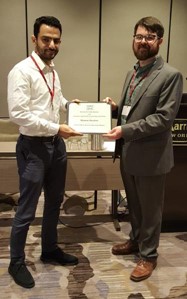
Marwan Alsultan, University of Virginia, “Risk-Cost-Benefit Analysis for Access Reconfiguration of Transportation Networks”
2017 Awardee
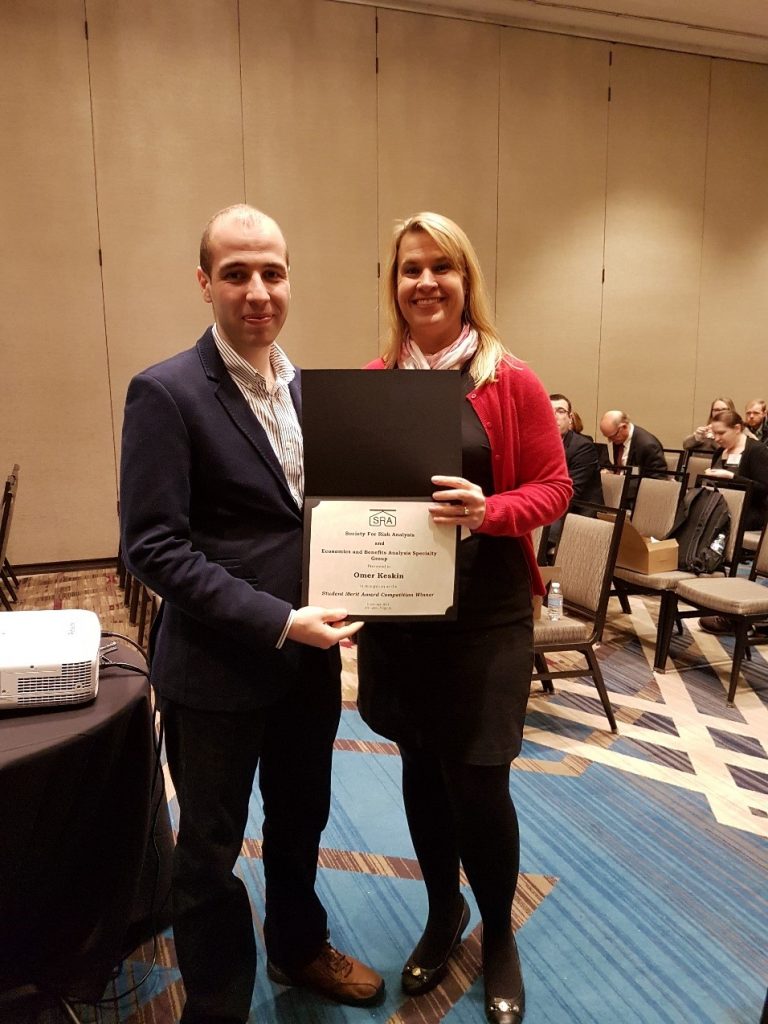
Omer Keskin, Old Dominion University, “Annualized Loss of Revenue Caused by Cyber-attacks for Power Generation in Virginia Using Agent-Based Modeling”
2014 Awardee

Laura Bakkensen, Yale University, “Risk and adaptation incentives: Evidence from global hurricane damages and fatalities”
2013 Awardee

Daniel Herrera, Toulouse School of Economics, “To fortify or not, a structural analysis of the public advisory policy on folic acid in France”
2012 Awardee
Magdalene Matthews, Cyprus International Institute for Environment and Public Health / Harvard School of Public Health, “National Burden of Disease Attributable to Selected Risk Factors: Cost Effectiveness of Proposed Environmental Health Interventions in a Recovering Liberia”.
2011 Awardee

Austin Mitchell, Engineering and Public Policy, Carnegie Mellon University, “The Economics of Environmental Reclamation for Shale Gas Development in Pennsylvania”.
2010 Awardee

Seth Baum, Pennsylvania State University, “Space-Time Discounting, Global Catastrophic Risk, and Climate Change Economics.”
2009 Awardee

Niam Yaraghi, Royal Institute of Technology (Sweden), “A Model for Integrating Quantitative Risk Analysis of Vendor’s Environmental Performance into Supplier Selection Process.”
2008 Awardee

Christoph M. Rheinberger, WSL Swiss Federal Institute for Snow and Avalanche Research, “Discrete Choice Experiments: False Friends for Valuing Mortality Risk?”